
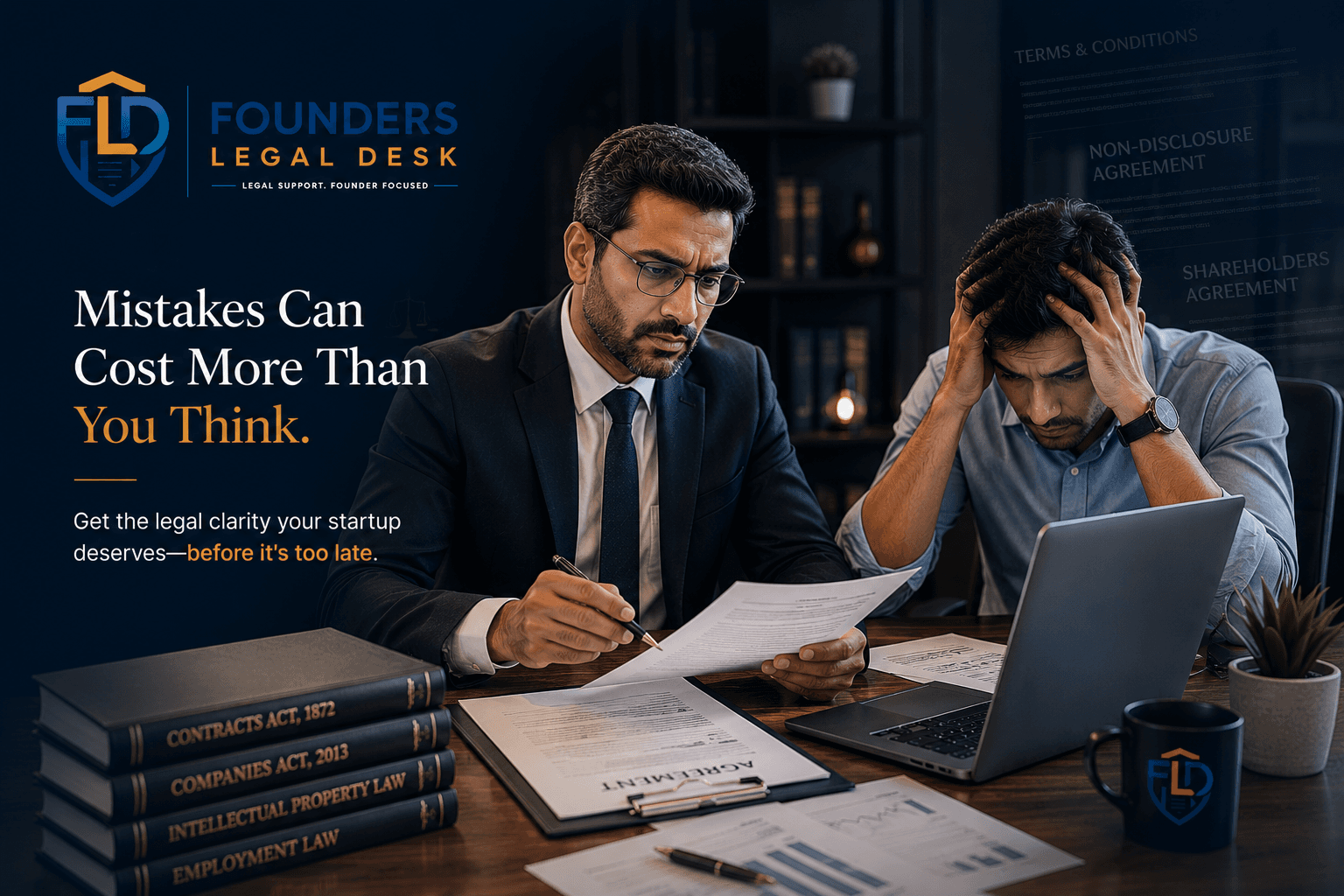
7 Legal Mistakes Founders Make in Their First Year (And How to Avoid Them)
The first year of building a startup feels like controlled chaos.
One day you're pitching investors, the next you're hiring your first employee, negotiating with vendors, or signing your biggest client. Amid all that momentum, legal paperwork often gets pushed to "later."
Until later becomes expensive.
We've seen founders lose equity over verbal promises, delay fundraising because of missing documentation, and receive trademark objections after investing heavily in branding. These aren't rare exceptions—they're some of the most common startup legal mistakes early-stage businesses make in India.
The good news? Most of them are entirely preventable.
In this guide, we'll break down the 7 Legal Mistakes Founders Make in Their First Year, explain why they happen, and show you practical steps to protect your startup before small legal gaps become major business risks.
Whether you're bootstrapping, raising your first round, or hiring your initial team, this guide serves as a practical startup legal checklist for India.
Why the First Year Is the Most Legally Vulnerable Stage
The first year is when founders make the highest number of business decisions with the least amount of legal structure.
That combination creates risk.
Why early-stage startups are more exposed
- Limited budgets often push legal work down the priority list.
- Fast decision-making leads to informal agreements.
- Founders rely on trust instead of documentation.
- Investor expectations increase as the business grows.
- Compliance deadlines continue regardless of startup size.
Imagine two friends launching a SaaS company.
They agree to split equity 50-50 over coffee. Six months later, one founder leaves after contributing very little. Without a written founder agreement, resolving ownership becomes complicated—and potentially costly.
The same pattern appears across contracts, trademarks, hiring, and compliance.
Think of legal foundations like the building's structure. Customers may never notice them, but they'll determine how safely your startup scales.
Mistake #1: Not Having a Founder Agreement
If there's one document every startup should prioritize early, it's a founder agreement.
Many co-founders assume friendship is enough.
Business rarely stays that simple.


What a founder agreement should cover
- Equity ownership
- Founder roles and responsibilities
- Decision-making authority
- Vesting schedules
- Exit provisions
- Dispute resolution mechanisms
Why it matters
A founder agreement answers difficult questions before they become emotional disputes.
For example:
Rahul builds the product. Aisha handles sales. After eight months, Rahul decides to leave.
Without vesting or exit provisions, he may still own half the company despite no longer contributing. That can become a major concern during investor due diligence.
Founder Agreement Checklist
| Clause | Why It Matters |
| Equity Split | Prevents ownership disputes |
| Vesting | Protects long-term commitment |
| Roles | Creates accountability |
| Exit Terms | Handles departures fairly |
| Decision Rights | Avoids deadlocks |
Mistake #2: Using Free Contract Templates
Google makes it incredibly easy to download "free legal templates."
Unfortunately, it also makes it easy to download contracts that don't fit Indian businesses.
Why generic templates create risk
Most free templates are:
- Written for foreign jurisdictions
- Missing Indian legal requirements
- Too generic for startup-specific situations
- Unbalanced in favor of one party


Contracts every startup typically needs
- Client agreements
- Vendor agreements
- Service contracts
- Non-Disclosure Agreements (NDAs)
- Employment contracts
- SaaS agreements
- Consulting agreements
A practical example
A marketing agency hires a freelancer using a generic online contract.
The agreement never states who owns the designs.
Months later, ownership becomes disputed because intellectual property rights weren't clearly assigned.
That single missing clause can delay product launches and create legal uncertainty.
What good startup contracts include
- Scope of work
- Payment terms
- Confidentiality
- Intellectual property ownership
- Limitation of liability
- Termination rights
- Governing law and jurisdiction
Professional contract drafting costs far less than resolving contract disputes later.
Mistake #3: Ignoring Trademark Protection
Your brand is one of your startup's biggest assets.
Yet many founders invest in logos, websites, and marketing before checking whether they actually own the name.


Why trademark registration matters
In India, trademark registration helps protect your brand identity and strengthens your legal position against unauthorized use.
Waiting too long creates unnecessary risk.
Common founder mistakes
- Assuming domain ownership equals trademark ownership.
- Launching before conducting a trademark search.
- Delaying filing until after marketing campaigns.
- Using names similar to existing trademarks.
What happens if someone files first?
Even if you've been using a brand name, another party's registration or earlier rights can create significant legal challenges.
That could mean:
- Rebranding costs
- Marketing losses
- Customer confusion
- Investor concerns
When should founders file?
As early as possible after choosing a distinctive brand name and completing a basic availability search.
A trademark is significantly cheaper than a complete rebrand.
Mistake #4: Missing Compliance Deadlines
Many founders assume compliance becomes important only after fundraising.
That's incorrect.
From incorporation onward, businesses have ongoing legal responsibilities.
Startup compliance in India often includes
- ROC filings
- GST compliance (where applicable)
- Accounting records
- Board resolutions
- Statutory registers
- License renewals
Missing deadlines can result in penalties and unnecessary complications.
Quarterly Compliance Checklist
- ROC filings reviewed
- GST returns filed (if applicable)
- Accounting records updated
- Licenses renewed
- Board documentation maintained
Why investors care
During due diligence, compliance gaps often become negotiation points.
Clean compliance records create confidence.
Messy records create questions.
Mistake #5: Hiring Employees Without Proper Agreements
Your first hire isn't just an operational milestone.
It's a legal one.
Many startups rely on informal offer letters or WhatsApp conversations.
That's risky.


Every employment agreement should address
- Job responsibilities
- Salary and benefits
- Notice period
- Confidentiality
- Intellectual property ownership
- Termination terms
Why IP clauses matter
Imagine your developer creates your core software.
If the employment agreement doesn't clearly assign intellectual property rights, ownership questions may arise later.
That becomes particularly important during acquisitions and fundraising.
Employee vs Contractor
| Employee | Contractor |
| Employment agreement | Service agreement |
| Company policies apply | Independent obligations |
| IP assignment essential | Separate IP clauses needed |
| Notice terms defined | Contract termination terms |
Proper documentation protects both founders and team members.
Mistake #6: Raising Money Without Proper Documentation
Fundraising isn't just about pitching.
It's about paperwork.
Investors don't only evaluate your product.
They evaluate your legal readiness.


Documents investors commonly review
- Founder agreements
- Cap table
- Shareholder agreements
- Board approvals
- IP ownership
- Employment agreements
- Compliance records
Common fundraising documentation
- Term sheets
- Shareholder agreements
- Share subscription agreements
- Convertible instruments (where applicable)
- Board resolutions
Why documentation matters
A missing signature or unclear equity record can delay investment even when investors want to proceed.
Legal preparedness speeds up due diligence.
Investors often interpret organized documentation as evidence of disciplined founders.
Mistake #7: Waiting Too Long to Get Legal Advice
Many founders think lawyers are only necessary during disputes.
The strongest startups use legal advice before problems appear.
Preventive legal support saves money
Instead of paying for litigation later, founders benefit from:
- Contract reviews
- Compliance reminders
- Trademark guidance
- Employment documentation
- Fundraising support
- Ongoing legal advisory


6
Think of legal support like a CFO
You wouldn't wait for a tax penalty before hiring an accountant.
Legal works the same way.
Early guidance helps founders make faster decisions with fewer risks.
When should founders get legal support?
Consider legal support when you're:
- Incorporating
- Adding co-founders
- Signing major contracts
- Hiring employees
- Raising funds
- Protecting intellectual property
Quick Founder Legal Checklist (Save This)
- Use this practical startup legal checklist every quarter.
- Founder agreement signed
- Roles, equity, vesting, exits, and decision rights documented.
- Trademark filed
- Brand search completed and trademark application initiated.
- Client contracts reviewed
- Scope, payment terms, IP ownership, and liability clauses checked.
- Vendor agreements finalized
- Commercial terms, confidentiality, and termination rights documented.
- GST and ROC compliance checked
- Applicable filings reviewed and deadlines tracked.
- Employment agreements completed
- Offer letters, confidentiality, and IP assignment clauses in place.
- Privacy policy published
- Customer-facing legal documents updated where relevant.
- Fundraising documents organized
- Cap table, board approvals, and key legal records ready for due diligence.
- This checklist is worth revisiting every three months.
How Founders Legal Desk Helps Startups
Building a startup means making hundreds of decisions.
Legal shouldn't become the bottleneck.
At Founders Legal Desk, we help founders build legally stronger businesses through practical, startup-focused support.
Our legal support includes
- Startup incorporation
- Founder agreements
- Contract drafting and review
- Trademark registration
- Startup compliance
- Employment documentation
- Fundraising legal documentation
- Ongoing legal retainership
Our approach focuses on helping founders prevent problems early while creating legal systems that support growth.
Rather than overwhelming businesses with legal jargon, we prioritize clear documentation, practical advice, and startup-specific solutions that fit different growth stages.
Frequently Asked Questions
What is the biggest legal mistake founders make?
Not documenting founder relationships early. A clear founder agreement helps prevent disputes over equity, roles, and exits.
Do startups need a lawyer in their first year?
Most startups benefit from legal guidance during incorporation, contracts, hiring, trademark registration, and fundraising preparation.
Should founders trademark their brand early?
Yes. Filing early helps strengthen brand protection and reduces the risk of costly rebranding later.
Are free contract templates legally safe?
Not always. Many generic templates are unsuitable for Indian startups or specific commercial situations.
What legal documents does every startup need?
A founder agreement, client contracts, vendor agreements, employment agreements, NDA, compliance records, and trademark documentation are among the most important.
What startup compliances are mandatory in India?
Requirements depend on your business structure but may include ROC filings, GST compliance where applicable, accounting records, and statutory documentation.
When should a founder hire legal counsel?
Ideally before signing major contracts, hiring employees, raising investment, or launching a brand.
Why do investors review legal documents?
Legal documentation helps investors verify ownership, compliance, intellectual property rights, and governance before investing.
How much does startup legal support cost?
Costs vary depending on services required, but preventive legal support is often significantly more affordable than resolving disputes later.
Can startups handle legal work themselves?
Founders can manage basic organization, but important contracts, trademarks, compliance, and fundraising documents usually benefit from professional legal review.
Final Takeaway
The first year of building a startup isn't about avoiding every mistake.
It's about avoiding the expensive ones.
Strong legal foundations don't slow growth—they make growth safer.
A founder agreement protects relationships.
Well-drafted contracts protect revenue.
Trademark registration protects your brand.
Compliance protects credibility.
And proactive legal guidance protects your future fundraising opportunities.
If you're building a startup in India, treating legal as a strategic advantage—not just a compliance requirement—can save significant time, money, and stress as your business scales.
Explore startup legal support through Founders Legal Desk to build a business that's prepared for growth from day one.
To contact us
Email- legal@founderslegal.com
Number- +91 9711752388
Website- https://founderslegaldesk.com/