
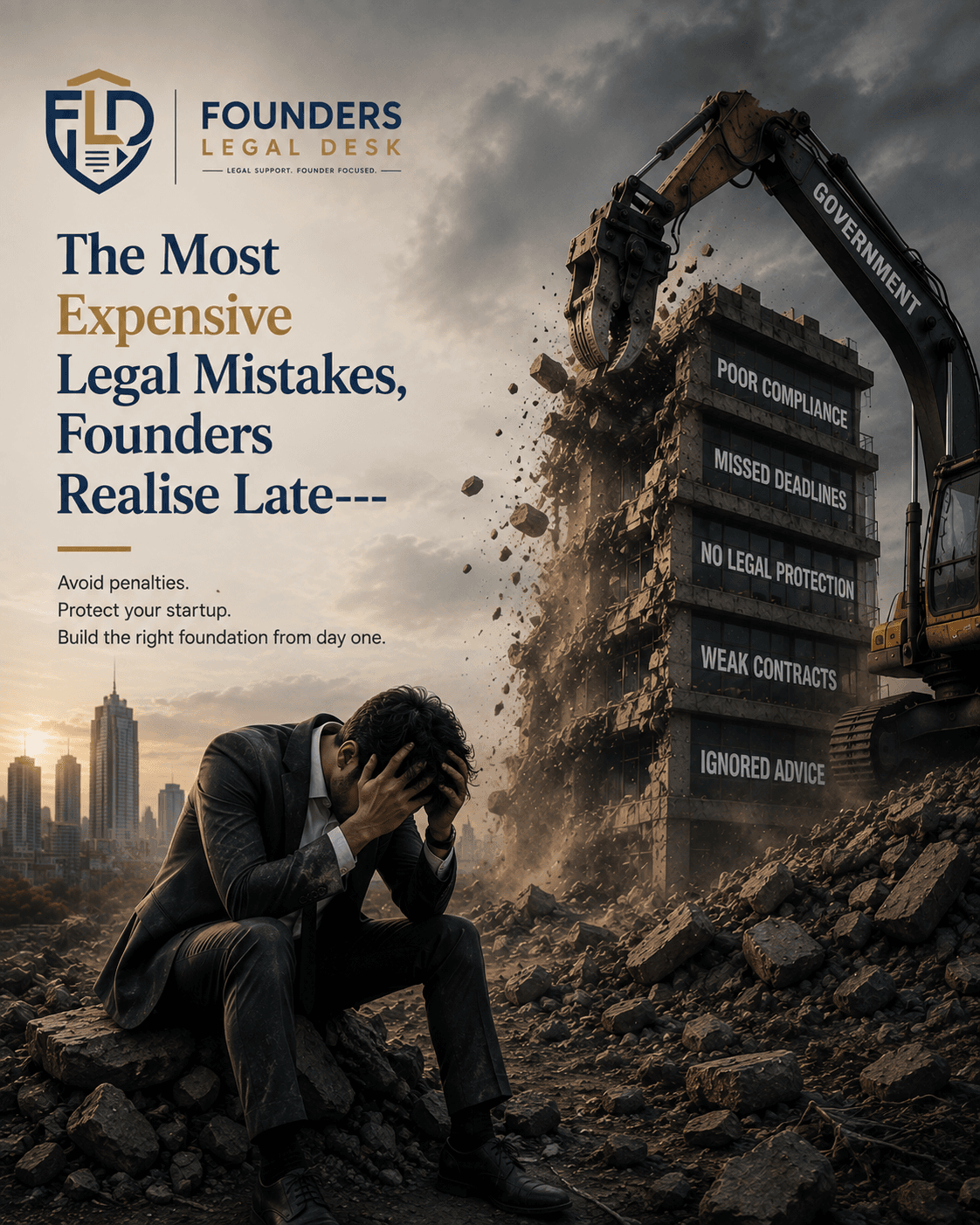
The Most Expensive Legal Mistakes Are Often the Ones You Don't Notice
Introduction
Three founders celebrate landing their biggest client.
Revenue is climbing, new employees are joining, and investors have started asking for meetings. The business finally feels real.
Then, six months later, everything slows down.
The client refuses to release the final payment because the contract never clearly defined the project's scope. A competitor launches under a confusingly similar brand name because the trademark was never filed. During an investor's due diligence process, missing compliance records raise questions that delay funding.
None of these problems appeared overnight.
They were quietly growing in the background.
The Most Expensive Legal Mistakes Are Often the Ones You Don't Notice. They're rarely dramatic at first. Instead, they're hidden inside unsigned contracts, forgotten compliance filings, verbal founder promises, and assumptions that "we'll fix it later."
For startups and MSMEs in India, these invisible legal gaps can become far more expensive than the legal support that could have prevented them. They consume management time, strain customer relationships, delay investment, and sometimes force businesses into avoidable disputes.
The encouraging news is that most of these risks are predictable.
This guide explores the hidden legal mistakes businesses make, explains why they become costly, and provides practical checklists to help founders build stronger legal protection before problems surface.
What are the most expensive legal mistakes businesses don't notice?
The most expensive hidden legal mistakes include weak contracts, delayed trademark registration, employment law gaps, missed compliance filings, and undocumented founder agreements. These issues often remain invisible until they trigger payment disputes, penalties, investor concerns, or costly legal action—making prevention significantly cheaper than fixing problems later.
1. Weak Contracts That Look Fine Until Something Goes Wrong
A contract doesn't prove its value when everything goes well.
It proves its value when someone disagrees.
One of the biggest legal mistakes businesses make is assuming that a downloaded template or email confirmation offers enough protection.
Why contracts fail
Many startups rush deals because speed feels more important than paperwork.
Unfortunately, unclear contracts create expensive misunderstandings.
Common problems include:
- Undefined deliverables
- Missing payment schedules
- No late-payment clause
- Weak termination rights
- No dispute resolution mechanism
- Missing liability limitations
Real business example
A software startup agrees to build a custom platform for ₹12 lakh.
The proposal lists features but never defines revision limits.
The client requests repeated changes for months.
The startup delivers far more work than originally planned but struggles to recover additional payments because the agreement never defined scope boundaries.
A clearer contract could have prevented months of conflict.
Warning signs your contract needs attention
- It was copied from Google.
- Payment terms are vague.
- "Work as discussed" appears repeatedly.
- There's no governing law clause.
- Intellectual property ownership isn't mentioned.
- Either party can terminate without clarity.
Essential Contracts Every Startup Needs
- Client Agreement — Protects revenue
- Vendor Agreement — Defines responsibilities
- Service Agreement — Clarifies deliverables
- NDA — Protects confidential information
- Employment Agreement — Reduces workplace disputes
- Founder Agreement — Protects ownership
Contract checklist
Before signing:
- Clear scope of work
- Payment milestones
- Late payment penalties
- Confidentiality clause
- Intellectual property ownership
- Termination procedure
- Dispute resolution
- Jurisdiction clause
Founder Tip: Every major commercial relationship deserves a legally reviewed agreement.
2. Delaying Trademark and Brand Protection
Your brand becomes valuable long before you realize it.
Many founders invest heavily in:
- Website development
- Logo design
- Social media marketing
- Packaging
- Advertising
But postpone trademark registration.
That delay can become extremely expensive.


What happens when someone copies your brand?
Imagine launching "UrbanNest."
You build customer trust over two years.
Then another company registers a confusingly similar trademark.
Suddenly, you're facing:
- Customer confusion
- Legal notices
- Rebranding costs
- Marketing losses
Recovering from that situation is significantly harder than protecting your brand early.
Trademark vs Copyright vs Patent
- Trademark — Protects your brand name and logo
- Copyright — Protects content, software, and designs
- Patent — Protects new inventions
Each serves a different purpose.
Many startups need more than one type of protection.
Don't forget your domain
Your brand isn't only your trademark.
Protect:
- Website domain
- Social media usernames
- Business email domains
Owning consistent digital assets strengthens both brand identity and legal protection.
Practical brand protection steps
- Conduct a trademark search.
- File your trademark early.
- Register important domains.
- Secure social handles.
- Keep ownership records.
- Use NDAs before sharing ideas.
Why investors care
During due diligence, investors often examine:
- Trademark ownership
- Software ownership
- IP assignments
- Brand documentation
Missing IP records can delay investment conversations.
3. Ignoring Employment Law Until an Employee Leaves
Hiring usually feels exciting.
Exits often reveal legal weaknesses.
Many founders focus on recruitment while overlooking documentation that protects the business later.


Essential employment documents
Every employee should receive:
- Offer Letter
- Employment Agreement
- Confidentiality Agreement
- Intellectual Property Assignment
- Company Policies
These documents create clarity for both employer and employee.
Confidentiality clauses matter
Employees often access:
- Customer databases
- Pricing information
- Product roadmaps
- Marketing plans
Without confidentiality obligations, protecting sensitive information becomes much harder.
What about non-compete clauses?
Indian businesses often ask about non-compete clauses.
While enforceability depends on legal circumstances, businesses can strengthen protection through well-drafted confidentiality obligations, IP assignments, and reasonable contractual safeguards.
Employee vs Contractor mistakes
This is a common startup compliance issue.
Treating contractors exactly like full-time employees can create legal and tax complications.
Always document the relationship properly.
Don't ignore POSH compliance
Growing businesses should understand workplace obligations under the POSH Act and assess when formal compliance requirements apply.
Waiting until a complaint arises creates unnecessary risk.
Exit documentation matters too
When employees leave, businesses should consider:
- Exit acknowledgments
- Return of company property
- Access revocation
- Confidentiality reminders
- Final settlement documentation
HR compliance checklist
- Offer letter issued
- Employment agreement signed
- NDA included
- IP assignment completed
- Employee records maintained
- POSH obligations reviewed
- Contractor relationships documented
- Exit process documented
4. Small Compliance Delays That Become Big Penalties
Some legal problems don't begin with disputes.
They begin with forgotten dates.
As businesses grow, compliance becomes increasingly important.
Missing one filing can create unnecessary costs and administrative complications.

GST compliance
Businesses registered under GST should maintain accurate records and file applicable returns on time.
Common mistakes include:
- Late filings
- Incorrect invoices
- Mismatched returns
- Record-keeping errors
ROC filings
Companies registered under the Ministry of Corporate Affairs have annual filing obligations.
Ignoring them can result in penalties and additional compliance burdens.
MSME registration
Udyam Registration offers valuable benefits.
However, registration isn't the end of compliance—businesses must continue meeting applicable legal obligations.
Directors have responsibilities
As companies grow, directors should understand that governance responsibilities expand alongside business operations.
Good documentation and timely filings help reduce unnecessary legal exposure.
Compliance overview
- Missed GST filings — Risk of interest and penalties
- Delayed ROC filings — May lead to regulatory action
- Unpaid or incorrect taxes — Can result in financial consequences
- Incomplete labour records — May create compliance issues
- Missing statutory registers — Can raise governance concerns
- Unclear compliance responsibilities — Important deadlines may be missed
- Outdated compliance information — Requirements may change based on your business structure
- No regular compliance review — Small issues can become bigger legal problems
Compliance Warning Signs
- No compliance calendar
- Last-minute filings
- Missing board records
- Poor document storage
- Unclear director responsibilities
Compliance checklist
- GST reviewed
- ROC filings completed
- Tax records organized
- Registers updated
- Professional review conducted annually
5. Founder Agreements Everyone Says They'll Draft Later
Few legal mistakes become more expensive than founder disputes.
The surprising part?
Most founder conflicts don't begin with bad relationships.
They begin with unclear expectations.
The handshake problem
Early-stage founders often say:
"We're friends."
Friendship isn't a legal framework.
Businesses change.
People's roles change.
Life changes.
Questions every founder agreement should answer
- Who owns what?
- What happens if someone leaves?
- How are major decisions made?
- Who owns intellectual property?
- How are disputes resolved?
Why vesting matters
Imagine:
Two founders split equity equally.
One leaves after four months.
Without vesting, that founder may continue owning a significant stake despite limited long-term contribution.
Vesting creates stronger alignment between ownership and contribution.
Decision-making rights
As businesses grow, disagreements become more likely.
Documenting voting rights early prevents confusion later.
Exit clauses
Founder agreements should address:
- Voluntary exit
- Forced exit
- Share transfers
- Buyback mechanisms
- Deadlock situations
Founder agreement checklist
- Equity documented
- Vesting included
- Roles defined
- Decision rights clarified
- Exit process documented
- IP ownership assigned
- Dispute mechanism included
Why investors notice this
Investors often review founder documentation during due diligence.
Missing agreements can create avoidable delays.
Hidden Legal Costs Most Businesses Never Calculate
When founders think about legal costs, they often imagine lawyer fees.
The bigger costs are frequently indirect.
1. Litigation expenses
Even resolving relatively straightforward disputes can consume months of management time alongside legal expenses.
2. Reputation damage
Legal conflicts can affect:
- Customer confidence
- Partner relationships
- Hiring
- Investor perception
3. Delayed funding
Investors may pause discussions when due diligence uncovers missing documentation.
4. Lost business opportunities
An unsigned contract or ownership dispute can delay commercial deals.
5. Operational disruption
Management attention shifts away from growth toward crisis management.
Example scenario
Consider a startup preparing for investment.
During due diligence, the investor discovers:
- No founder agreement
- Missing IP assignments
- Weak employment contracts
The funding process slows while documentation is completed.
The legal issue isn't necessarily the documents themselves—it's the delay they create.
A Legal Prevention Checklist Every Founder Should Follow
Think of this as your quarterly legal health check.
Save it.
Review it.
Update it as your business grows.
- Business Foundation
- Company registration documents updated
- Udyam registration reviewed
- Business licenses verified
- Contracts
- Client agreements reviewed
- Vendor contracts updated
- Service agreements standardized
- NDAs signed where needed
- Brand & IP
- Trademark filed
- Domain ownership confirmed
- IP ownership documented
- Employment
- Employment agreements signed
- Confidentiality clauses included
- Exit procedures documented
- Compliance
- GST filings reviewed
- ROC filings completed
- Statutory records maintained
- Founder Protection
- Founder agreement signed
- Shareholder documentation updated
- Vesting terms reviewed
- Data Protection
- Customer data handled securely
- Privacy documentation reviewed
- Access controls updated
Treat this checklist like preventive maintenance for your business.
When Should You Consult a Legal Partner?
Many founders wait until they receive:
- A legal notice
- A customer dispute
- An employee complaint
- An investor request
- A compliance penalty
By then, the cost of solving the problem is often much higher than the cost of preventing it.
A proactive legal partner helps businesses:
- Draft stronger contracts
- Protect intellectual property
- Build founder documentation
- Stay compliant
- Prepare for due diligence
- Resolve risks early
Instead of reacting to problems, startups benefit from legal support that grows alongside the business.
Founders Legal Desk works with startups, founders, and MSMEs across India to help build legally stronger businesses through practical, founder-friendly legal guidance.
Frequently Asked Questions
1. What are the biggest legal mistakes startups make?
Weak contracts, delayed trademark registration, missing founder agreements, employment compliance gaps, and ignored regulatory filings are among the most common mistakes.
2. Why are hidden legal mistakes so expensive?
Because they often remain unnoticed until they create disputes, penalties, delayed funding, or business disruptions.
3. What legal documents does every startup need?
Founder agreements, client contracts, employment agreements, NDAs, vendor agreements, and service contracts.
4. Is trademark registration necessary?
While not mandatory for every business, trademark registration provides valuable legal protection for your brand.
5. What happens if founders don't sign an agreement?
Disputes over ownership, exits, decision-making, and intellectual property become significantly harder to resolve.
6. What compliance should MSMEs follow?
Depending on the business structure, MSMEs may need to comply with GST, MCA filings, labour laws, tax obligations, and other applicable regulations.
7. Can poor contracts lead to lawsuits?
Yes. Unclear contracts often contribute to payment disputes, disagreements over deliverables, and other legal conflicts.
8. How can startups reduce legal risks?
By using professionally drafted contracts, protecting intellectual property, documenting founder arrangements, and maintaining compliance.
9. When should a founder hire a legal advisor?
Ideally before signing major contracts, hiring employees, raising investment, launching a brand, or responding to legal notices.
10. What legal protections should a growing business have?
A growing business should have strong contracts, trademark protection, founder agreements, employment documentation, compliance systems, and proper record-keeping.
Conclusion
The legal mistakes that hurt businesses most rarely arrive with warning signs.
They hide inside vague contracts, delayed trademark filings, undocumented founder promises, forgotten compliance dates, and missing employment paperwork.
The Most Expensive Legal Mistakes Are Often the Ones You Don't Notice, but they're also among the most preventable.
Founders who invest in legal clarity early don't just reduce risk—they build stronger businesses that are easier to scale, easier to fund, and more resilient during growth.
If you're building a startup or growing an MSME in India, now is the right time to strengthen your legal foundation.
Book a consultation with Founders Legal Desk and protect your business before invisible legal risks become expensive problems.
To contact us
Email- legal@founderslegal.com
Number- +91 9711752388
Website- https://founderslegaldesk.com/