
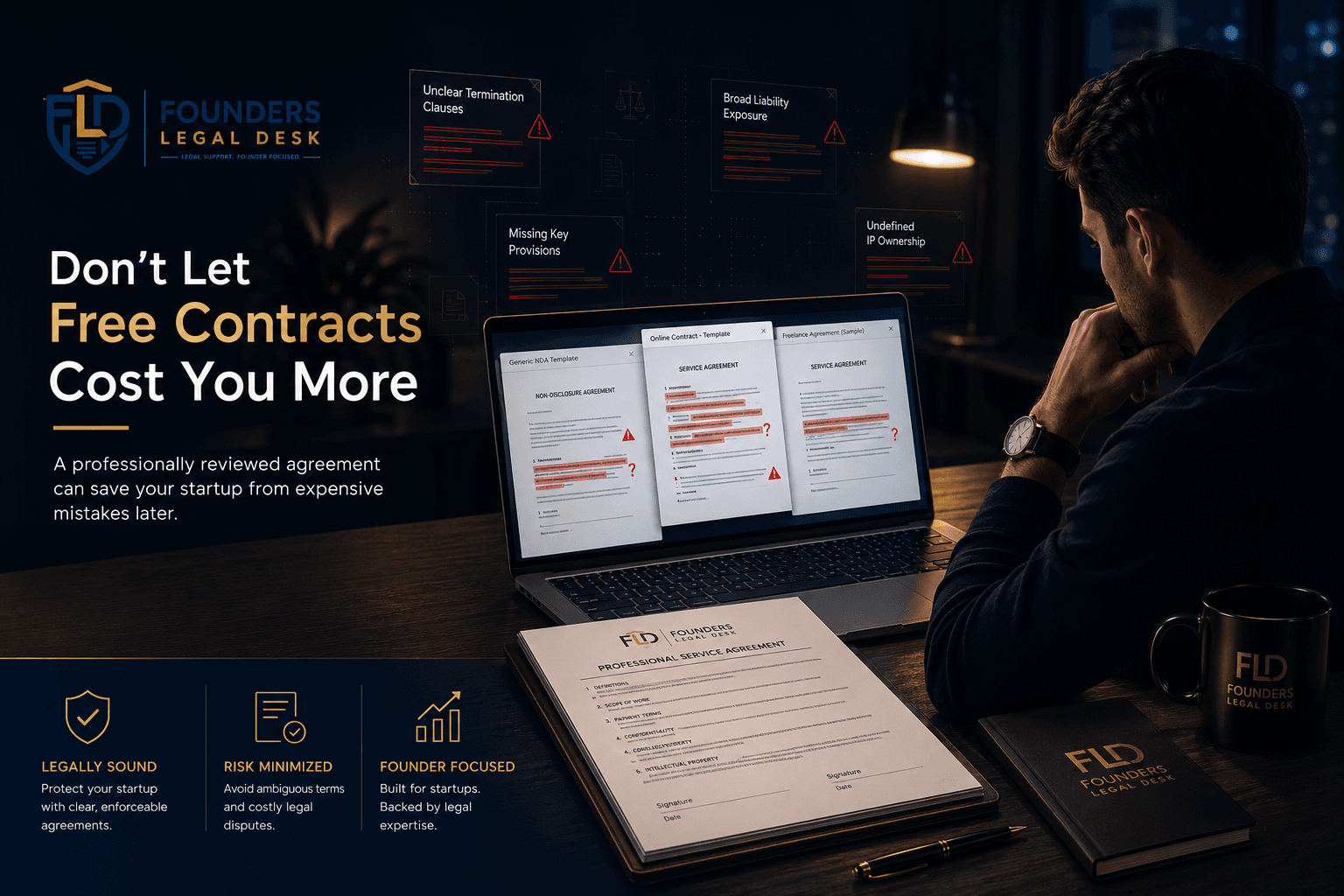
Why Founders Should Stop Copy-Pasting Contracts From Google (Before It Costs Them Thousands)
A founder lands their first paying client.
Excited to move quickly, they search "free client agreement template" on Google, download the first result, replace the company name, and send it within five minutes.
The project begins immediately.
A month later, payment is delayed. The client argues that unlimited revisions were included. The founder insists they weren't. Then another question appears:
"Who actually owns the work?"
The template doesn't provide clear answers.
This is one of the most common legal contract mistakes startups make. The issue isn't that Google contract templates are automatically invalid—it's that they're often written for a different business, a different jurisdiction, or a completely different commercial relationship.
In this guide, we'll explain why founders should stop copy-pasting contracts from Google, when free templates become risky, what every startup contract should include, and how better documentation can save time, money, and investor headaches later.
Why Founders Love Google Contract Templates
Let's be honest.
There's a reason founders keep searching for free templates.
They're fast.
They're free.
And when you're bootstrapping, every expense feels important.
Why founders rely on Google templates
- Limited budgets
- Urgent client deadlines
- DIY startup culture
- Early-stage hiring pressure
- A false sense of security
Imagine you're building a SaaS startup.
A customer wants to sign today.
Spending hours drafting a contract feels like friction.
So downloading a template feels practical.
The problem isn't speed.
The problem is assuming every business relationship works the same way.
Are Google Contract Templates Actually Legal?
Yes—but that's not the real question.
A contract template isn't automatically invalid simply because it came from Google.
The better question is:
Does it actually fit your business?
A useful contract should match:
- your commercial relationship,
- Indian legal requirements,
- your payment model,
- your intellectual property structure,
- your dispute resolution preferences.
A perfectly valid template written for a US consulting business may still be a poor fit for an Indian SaaS startup.
That's where risk appears.
The Biggest Risks of Copy-Pasting Contracts
Most founders don't notice contract problems while everything is going well.
They notice them when something goes wrong.
Let's look at the biggest risks.
1. Missing Business-Specific Clauses
Generic contracts rarely understand your business model.
For example, a SaaS startup may need clauses covering:
- subscription renewals,
- uptime commitments,
- customer data,
- service levels.
A generic consulting agreement probably won't include those.
Example
A SaaS company copies a consulting template.
A customer requests refunds after downtime.
The agreement never addressed service interruptions.
Now expectations become unclear.
2. Wrong Jurisdiction
Many free templates are written for:
- US law,
- UK law,
- Australian law.
Those references may not align with Indian commercial relationships.
Example
A contract refers to California law.
Both businesses operate entirely in India.
That creates unnecessary complexity that could have been avoided with proper drafting.
3. Weak Payment Protection
This is one of the biggest startup risks.
A strong contract should clearly define:
- payment timelines,
- milestones,
- late payment expectations,
- invoice triggers.
Many generic templates keep these clauses extremely broad.
Example
A startup completes a ₹5 lakh project.
The client says payment depends on "final approval."
The agreement never defined what approval actually means.
4. Intellectual Property Confusion
Who owns:
- software,
- designs,
- content,
- branding,
- AI-generated assets?
Many founders assume paying someone automatically transfers ownership.
It often isn't that simple.
Clear intellectual property clauses help avoid confusion before valuable assets become disputed.
5. Missing Termination Rights
Every agreement eventually ends.
The question is whether your contract explains how.
Good termination clauses answer questions like:
- How much notice is required?
- What happens to unpaid invoices?
- What happens to confidential information?
Generic templates often leave these answers incomplete.
6. Poor Dispute Resolution Clauses
Nobody signs a contract expecting a dispute.
But if one happens, the agreement should explain:
- how disputes are handled,
- where they're handled,
- what happens first.
Clear dispute resolution language reduces unnecessary uncertainty later.
Real Startup Situations Where Generic Contracts Fail
Let's move beyond theory.
Here are situations founders regularly encounter.
Scenario 1: SaaS Startup Signs Its First Client
A B2B SaaS startup copies an online template.
The client requests features that weren't originally discussed.
The contract never clearly defined:
- implementation scope,
- support,
- change requests.
Practical takeaway
Software businesses need contracts that reflect software businesses.
Scenario 2: Freelancer Builds Your App
A freelance developer builds your MVP.
Payment is completed.
Months later, ownership questions appear.
Practical takeaway
Contractor agreements should clearly address intellectual property assignment.
Scenario 3: A Co-Founder Leaves
Two founders split equity verbally.
One leaves after six months.
Investors later ask about vesting.
Nothing was documented.
Practical takeaway
Founder agreements prevent ownership uncertainty before fundraising begins.
Internal Link: FounderAgreementServicesFounder Agreement Services
Scenario 4: Investor Begins Due Diligence
Everything looks promising.
Then investors request:
- founder agreements,
- client contracts,
- employment agreements,
- IP documentation.
The documents are inconsistent.
Practical takeaway
Clean legal documentation speeds due diligence.
Scenario 5: Vendor Breaches the Agreement
A vendor misses delivery deadlines.
The copied template never defined remedies.
Now expectations become difficult to enforce.
Practical takeaway
Vendor agreements deserve the same attention as customer contracts.
Free Contract vs Custom Startup Contract
Here's the difference at a glance.
| Factor | ||
| Business Fit | Low | High |
| Indian Law Alignment | Uncertain | Tailored |
| IP Protection | Often Weak | Strong |
| Payment Clauses | Generic | Customized |
| Investor Confidence | Lower | Higher |
| Commercial Terms | Limited | Business-specific |
| Risk Allocation | Basic | Balanced |
Why customized contracts matter
Custom contracts aren't about making documents longer.
They're about making expectations clearer.
The better your agreement reflects your actual business relationship, the fewer assumptions everyone has to make later.
What Every Startup Contract Should Include
Think of this as your universal contract checklist.
Essential contract elements
| Clause | |
| Parties | Identifies who is involved |
| Scope | Defines responsibilities |
| Payment Terms | Protects revenue |
| Deliverables | Prevents scope creep |
| Timelines | Creates accountability |
| Confidentiality | Protects sensitive information |
| IP Ownership | Clarifies ownership |
| Termination | Explains exits |
| Limitation of Liability | Allocates commercial risk |
| Dispute Resolution | Defines conflict process |
| Governing Law | Creates legal clarity |
| Signatures | Confirms agreement |
Parties
Always identify the correct legal entities.
Scope of Work
The clearer the scope, the fewer revision disputes.
Payment Terms
Document:
- pricing,
- milestones,
- invoices,
- payment timing.
Deliverables
Avoid vague promises.
Specificity creates alignment.
Timelines
Define expectations for both sides.
Confidentiality
Protect sensitive business information.
Intellectual Property Ownership
This matters far more than many founders realize.
Termination
Every agreement should explain how relationships end.
Limitation of Liability
Commercial relationships should allocate risk thoughtfully.
Dispute Resolution
Clear processes reduce unnecessary friction.
Governing Law
Ensure legal language matches your intended jurisdiction.
Signatures
A draft isn't the same as an executed agreement.
Which Contracts Should Never Be Copy-Pasted?
Some contracts deserve particular attention.
Founder Agreement
Perhaps the highest-priority startup document.
Covers:
- equity,
- vesting,
- exits,
- decision-making.
Shareholder Agreement
Critical as ownership becomes more sophisticated.
Employment Agreement
Protects confidentiality and IP ownership.
Contractor Agreement
Especially important for freelancers creating valuable assets.
Client Agreement
Revenue deserves protection.
SaaS Agreement
Software businesses have unique commercial realities.
Vendor Agreement
Suppliers affect delivery.
Documentation matters.
NDA
Confidentiality deserves careful drafting.
The Hidden Cost of Free Contracts
The biggest cost isn't the template.
It's what happens afterward.
Hidden business costs
| Cost | |
| Lost Payments | Invoice disputes |
| Scope Creep | Unlimited revisions |
| Ownership Disputes | IP confusion |
| Investor Delays | Missing documentation |
| Brand Risk | Trademark complications |
| Legal Costs | Preventable disputes |
Saving twenty minutes upfront can create weeks of cleanup later.
Can AI Generate Contracts?
This is becoming one of the fastest-growing founder questions.
The balanced answer is:
Yes—AI can help generate drafts.
But drafting isn't the same as tailoring.
AI may help with:
- first drafts,
- structure,
- brainstorming clauses.
Business-specific customization still matters.
A startup hiring employees, licensing software, or negotiating enterprise contracts usually benefits from reviewing whether the document actually reflects the commercial relationship—not just whether it sounds legal.
How Investors View Poor Contracts
Investors often evaluate legal organization as much as legal documents.
During due diligence, they'll commonly review
- founder agreements,
- employment documentation,
- client contracts,
- IP ownership,
- governance records,
- compliance documentation.


Strong documentation communicates operational maturity.
Messy paperwork creates unnecessary questions.
Even interested investors may slow the process while documentation gets cleaned up.
Founder's Contract Review Checklist (Save This)
Before signing any agreement, review these ten questions.
Company details are correctNames and legal entities verified.
Payment terms are clearAmounts, milestones, and timing documented.
IP ownership is definedOwnership and assignment terms addressed.
Confidentiality existsSensitive information protected.
Termination rights are fairExit rights and obligations are balanced.
Liability is reasonableCommercial risk allocation reviewed.
Dispute resolution is includedProcess and jurisdiction clarified.
Governing law matches the dealJurisdiction aligns with the intended legal framework.
Deliverables are specificScope is clearly documented.
Signatures are completeExecution is properly completed.
This checklist works for clients, vendors, contractors, and many commercial agreements.
Common Contract Mistakes Founders Make
Across early-stage startups, these mistakes appear repeatedly.
Copy-pasting without reading
Replacing the company name isn't customization.
Using foreign-law templates
Different jurisdictions create different assumptions.
Ignoring payment clauses
Revenue deserves precision.
Missing signatures
Execution matters.
Forgetting IP assignment
Ownership deserves clarity.
Using outdated templates
Businesses evolve.
Contracts should evolve too.
How Founders Legal Desk Helps
Founders Legal Desk helps startups build contracts that match how modern businesses actually operate.
Our support includes:
- Contract drafting
- Contract review
- Founder agreements
- Employment agreements
- Vendor contracts
- NDAs
- Legal retainership
Rather than treating contracts as paperwork, we help founders create legal systems that support hiring, fundraising, customer relationships, and long-term growth.
Frequently Asked Questions
Is it legal to use a contract template from Google?
Yes, but legality alone doesn't mean the template is suitable for your business, jurisdiction, or commercial relationship.
Can startups use free contract templates?
Free templates can be a starting point, but founders should review whether the document actually reflects their business needs before relying on it.
What's the biggest risk of copy-pasting contracts?
Payment disputes, unclear ownership, missing clauses, and commercial uncertainty are among the most common risks.
Do startups need customized contracts?
As businesses grow, contracts that reflect their specific commercial relationships become increasingly valuable.
What should every client agreement include?
Scope, payment terms, timelines, confidentiality, IP ownership, termination, governing law, and signatures.
Can AI replace contract drafting?
AI can help generate drafts, but business-specific customization and legal review remain important.
Why do investors review contracts?
Contracts help investors evaluate ownership, governance, commercial relationships, and operational readiness.
What's the first contract every founder should create?
For multiple founders, a founder agreement is often one of the earliest priorities.
Are online contract templates enforceable in India?
A template isn't automatically unenforceable, but whether it's appropriate depends on its terms, execution, and suitability for the specific business relationship.
How often should startups review contracts?
Review contracts whenever your business model changes, before major commercial relationships, and periodically as part of good legal housekeeping.
Final Takeaway
Saving ten minutes with a copied contract can cost months of legal trouble later.
The strongest founders don't treat contracts as downloadable forms.
They treat them as business assets.
A well-drafted agreement doesn't just reduce legal risk—it creates clearer expectations, stronger customer relationships, smoother fundraising, and greater confidence as your startup grows.
If you're building a startup in India, investing in better contracts today is often far cheaper than fixing preventable disputes tomorrow.
Explore Founders Legal Desk's startup legal services—from contract drafting and founder agreements to employment documentation, contract review, and ongoing legal retainership—to build agreements that grow with your business.
To contact us
Email- legal@founderslegal.com
Number- +91 9711752388
Website- https://founderslegaldesk.com/